
Heavier is Better
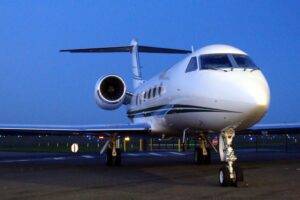
As we move into the Big Beast of Private Jet Travel, we decided to list the Top Three Heavy Jets to Charter. These are the aircraft most requested to accomplish the longer range trips while stepping up your overall game. They are big in comfort, long in range, and full of creature comforts the executive traveler must have in their charter. We will go over a nice list of three here starting with the Gulfstream GIV-SP, then we will look at its fiercest competitor, the Bombardier Challenger 604, and finally the sweetheart Dassault Falcon 2000LX. These aren’t necessarily the newest or greatest but they are the top three dynamos of the Heavy jet charter brigade. Some tail numbers may have their best years behind them, but most still represent great value and excellent charter options without sacrificing luxury and comfort. Many have been refurbished with modern interiors, but there are a few out there that still look like they could use some TLC. So lets take a look at the GIV-SP for your next transcontinental trip.
#1 The Gulfstream GIV-SP
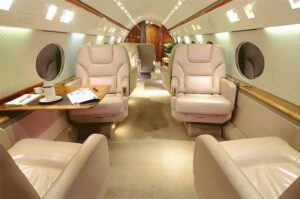
It’s easy to rank the Gulfstream GIV-SP in the Top Three Heavy Jets to Charter. The operational history of the GIV-SP and its military variants add to the cool factor of this aircraft. It is the plane of choice for the Hurricane Hunter selected by NOAA (National Oceanic and Atmospheric Administration). Their version was modified to carry scientist up to 45,000 ft ceilings and all around tropical cyclones. They drop instruments called “dropsondes” to measure all the critical data from a building storm such as windspeed, barometric pressure, humidity, and temperatures. The reason the GIV-SP was well suited for this task is because it can fly long distances with ample cabin space for equipment and crew while being tough enough to stand up to the beating the hurricane hunters put them through. The military variant of this aircraft is the the C-20F that the Army utilizes. It can be configured for both cargo and 26 passenger operations or a little bit of both. It is also used by the Navy, Marines, and the U.S. Air Force as command/executive transport roles (flying around the top brass). The GIV-SP is comparable to the Gulfstream III but with an aerodynamic redesign of the wing to lower weight, reducing drag, and increasing overall range. The SP stands for “Special Purpose” and appeared at serial number 1214 in 1993. Two Rolls Royce TAY 611-8 engines provide 13,850 lbs of thrust each. Sixteen passengers can be seated in three separate living areas. We find the more popular layouts to be the 14 passenger cabins or the 10 passenger cabin with 4-club space arrangement forward, a 2-place club and divan in the middle, then another 4-place conference seating in the rear. A full service galley can be located in the forward of aft compartments. Baggage is a roomy 169 cubic feet of space. Over 300 of these were built with production ending in 2002. The interior cabin height is a tall 6′ 1″ and a width of just over 7 feet. Maximum takeoff weight is a heavy 74,600 lbs with a max payload of 5300 lbs. The GIV-SP boasts a 45,000 ft ceiling altitude with an average range of 3,880 nautical miles. You will experience a normal cruise speed of 476 kts with a maximum speed closer to 500 kts. Typically the average hourly charter rate for a Gulfstream GIV-SP runs about $8,500* USD.
#2 Bombardier Challenger 604

Introduced in 1995, the Bombardier Challenger 604 is loved by executives and businesses because of its typically lower charter costs than the GIV-SP and other long range business jets. The successor to the CL-601 was one of the first business jets designed with a super-critical wing offering improved range, dependability, reliability, and outstanding performance. The Challenger 604 is a powerful heavy jet. This #2 pick in the category is powered by two General Electric CF34-3B engines that produce 8,729 lbs of thrust each. The plane can attain .74 Mach, but you can expect an economical cruising speed closer to 425 kts. With its fuel distribution and greater fuel capacity, the 604 can reach over 4,000 nautical miles range (NBAA 4Pax IFR Reserves 200 NM Alt). The cockpits have the Collins Pro Line 4 with six screens, left and right primary displays, multifunction displays and EICAS. The avionics suite is top notch with flight director/autopilot systems, HF-9000 high frequency radios, digital air data computers, turbulence detection radar, and dual Pro Line 400 all-digital interface comm/nav/ident radios. The standup height in the cabin is 6′ 1″ with a roomy 8.2 ft cabin width. Maximum capacity can be a tight 19 passenger layout, but a roomier 10-12 passenger layout is more common. You can expect to see forward club, half club, divan, or double club layouts. Galleys and Lavatories in the 604s are usually large. The Challenger 604 has a maximum altitude of 41,000 feet with a max take off weight of 48,200 lbs. The baggage space is ample for long trips at 115 cu ft. The average hourly charter rate for the Bombardier Challenger 604 is about $7,500* USD.
#3 Dassault Falcon 2000LX
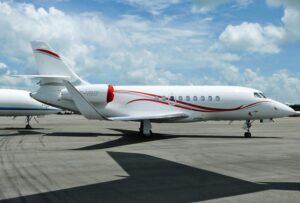
The Dassault Falcon 2000LX is our third top pick for transcontinental Heavy Jets for charter service. It was a development of the 2000EX and 2000EX EASy and entered the market in 2007. This jet boast having the size and comfort of a large cabin with the efficiency of a light jet. Having similar 4,000 nautical range capability like the GIV-SP and the 604 Challenger, the Falcon 2000LX fills out this special grouping of heavy jets. The impressive addition of winglets set this airframe apart from its predecessors of the 2000 series of Falcons as well as added significant fuel savings and range. In the cockpit, pilots will be behind the Rockwell Collins Pro Line 4 with a fully integrated avionics suite, including the Honeywell EASy avionics panel, Allied GNS-XES flight management system, Collins TWR-850 Doppler weather radar, and a dual channel fully integrated avionics processor system. The power comes from twin Pratt & Whitney Canada PW308C engines making the 2000LX capable of cruising at a fast 482 knots while comfortably carrying 10 passengers. You will find the cabin to be spacious and comfortable. The headroom is a nice and tall 6’2″ while an overall 7’8″ width. Passengers booking the 2000LX can enjoy over 1,000 cubic feet of interior space that gives them nice freedom of movement and legroom. You could seat up to 19 passengers in the cabin with the correct seat configuration, but we find most with seating for eight to ten passengers. The last one I was on had multiple lounge areas, seats that folded down into beds, a forward galley, and full aft lavatory. It had plenty of room for the baggage at 131 cubic feet and a max takeoff weight of 42,800 lbs. The Dassault Falcon 2000LX will usually have a $7,000* USD per hour charter rate.
It’s all about the range and comfort when it comes to these three heavy jets. If you want the best, I’d say take the Gulfstream GIV-SP. Looking to save a few bucks, well the Bombardier Challenger 604 with that updated interior from two years ago will be the obvious choice. Now if you want to impress the people meeting you on the tarmac when you land, few others will look cooler than a Dassault Falcon 2000LX pulling up to the FBO. Next week we go even larger, exploring the corporate behemoths in the Ultra Long-Range Business Jet Category.
Until Then, Be Social, Fly Private! Sign Up Today! Follow us on Facebook Follow us on Instagram
*These are base hourly rates per craft type with no ferry times, FET taxes, taxi time, or fuel surcharges. Typical final hourly rates will be higher based on category and timing.
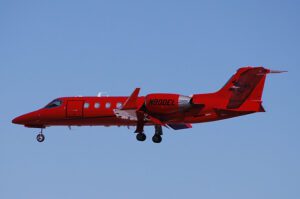
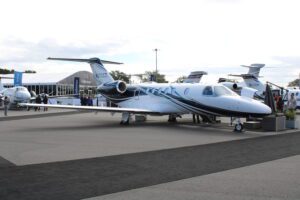
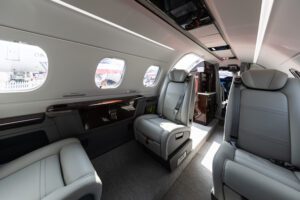
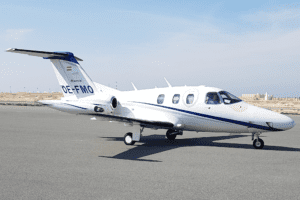
 Size matters when its a private jet charter. Luckily there are a lot of jet sizes to choose from when it comes to selecting your charter. They start in the category of very light jet all the way to a Boeing Business Jet that is the size of a commercial airliner. Today we will take a look at the entry level of the 4 categories in the air charter world, the very light jets. Since there are many in this category, we will discuss 3 of the hotter very light jets. It really comes down to what the mission is and how many people will be aboard. It also can have a lot to do with who will be flying. Sometimes the CEO will need his or her own space away from the travel group, and then only certain jets will do. Or the trip is for a large group and the seating capacity will be the main priority. Cargo space may be a deciding factor for a golfing weekend or a fashionista with an entourage of luggage. There are also various cruise speeds and the range flown without a fuel stop to consider. All in all, the process of choosing the right jet for a charter can be simple or at times very complex, especially on a multi-leg tour. Let’s look at the Very Lights this week.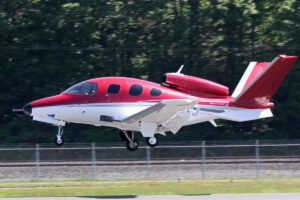
 The 50 hour guideline for flying private.
 Private air charter has many challenges ahead. Pictured above is one of our Managing Partners, Katherine Koch, my darling wife and future commercial ATP pilot. Unfortunately she only represents a small number of future commercial pilots headed towards the private air charter industry or a major commercial airlines. The pilot shortage is private aviation’s number one challenge, further exacerbated by competition for pilots from airline and freight operations. The airlines are offering huge sign-on bonuses, great work schedules, amazing benefits packages, and lofty annual salaries particularly for anyone experienced enough to graduate to the left seat of these jets. After forcing early retirements during the pandemic, the majors are desperately playing catch-up in this highly competitive industry. Upward mobility was already accelerated before the pandemic but now in the aftermath pilots are upgrading at minimums and jumping from regional to major airlines with unprecedented speed. There is a huge presence in aviation schools by most of the regional airlines that feed these major carriers, something we are not seeing enough of by the private air charter industry. It is a major challenge among many others we will discuss further in this article. In this article, we will take a quick look back 5 years ago at the challenges to private air charter that have shaped the current industry. In next week’s post, we will take a deeper dive into the current private air charter industry.
 Private Flying Rules: FAA Part 91, 121, 135. There are numerous rules and regulations governing all air travel, but let’s take a look at the three most of us fly under. FAA Part 121, covering Domestic, Flag and Supplemental Operations, is the most familiar as it is what all commercial airlines fly under including the major airlines and the regionals. Since we focus primarily on private air travel, charter, emptylegs, et cetera, we will most likely be flying under FAA Part 135 and in our own planes, FAA part 91.
  When we need to get out of harms way. Hurricane Ian’s insured losses continue to mount. Estimated losses are ranged from 53 to 74 billion dollars from Florida to the Carolinas. The modeling firm, RMS *, estimates that the damage will be very close to $67 billion in insured losses. These figures will rank Hurricane Ian as the All-Time costliest storms to hit Florida and place it 2nd only to Hurricane Katrina nationally as pertaining to insured losses. Densely populated areas such as Naples, Ft. Myers, and the barrier Island Sanibel were devastated and the death toll has already surpassed 100 souls**.
 Hurricane Ian will go down in history as one of the worst storms to impact the state of Florida in decades. It devastated the west coast of Florida with near Category 5 winds, torrential and unrelenting rain, plus a whopping 12+ ft storm surge. Like its predecessor, Hurricane Andrew, it caused death and destruction in the billions of dollars. 30 years ago, Hurricane Andrew caused 50 billion in damage, destroyed 60,000 homes, and left 170,000 people homeless. We haven’t had enough time to tally the pain caused by Hurricane Ian, but I’m sure the numbers will dwarf those of Andrew. Most of the areas hit were swamps and mangroves back in the early 1900s until men like Carl Fisher and Henry Flagler etched out their respective fortunes turning these same natural landscapes into concrete and coral stone. We no longer have the protection from mother nature’s palm trees, everglades, and mangroves to protect us. Although newer multi-million dollar homes and buildings are engineered with strength to endure these natural disasters, they seem not as well suited for battle as these weather events get more and more powerful with our ever changing climate and environment.